

Stretch Wrapping Machine for Electronics: ESD-Safe Packaging Guide 2026
A stretch wrapping machine for electronics must meet three non-negotiable requirements: electrostatic discharge (ESD) control, contamination prevention, and precision tension management — because a single static spark as low as 100 volts can destroy a microchip without any visible sign of damage.
Electronics packaging is not the same as wrapping bricks. If your factory ships printed circuit boards (PCBs), semiconductors, consumer electronics, or LED displays, the stretch wrapping machine you choose can be the difference between zero-field failures and costly warranty claims that surface months after delivery.
This guide covers everything procurement managers and plant engineers need to know about selecting, configuring, and operating stretch wrapping machines for electronics — from ESD film specifications to machine type selection and integration with cleanroom environments.
Why Electronics Require a Different Approach to Stretch Wrapping
The Three Invisible Threats
Electronics loads face risks that standard food, beverage, or chemical pallet wrapping simply does not address:
Tribocharging from stretch film — Standard LLDPE stretch film generates static electricity during unwinding and wrapping. When film rubs against cardboard cartons or bare electronic housings, it can accumulate surface charges exceeding 1,000 volts — enough to destroy sensitive CMOS circuits, microprocessors, and LED chips.
Dust attraction on charged surfaces — Static-charged film acts as a dust magnet. In electronics packaging, particulate contamination on bare PCB edges or connector contacts can cause intermittent failures that pass initial QC but fail in the field weeks later.
Point-load pressure on component leads — Over-tightened stretch film creates concentrated pressure points that can bend component leads, crack solder joints, or delaminate surface-mount devices (SMDs). Electronics demand precise, uniform containment force — not maximum tension.
The Cost of Getting It Wrong
Unlike a damaged chemical drum or a dented建材 package, electronics damage is often invisible at the point of packaging. A microchip weakened by ESD may pass factory testing but fail 30–90 days after delivery, triggering:
Warranty claims averaging $100–$500 per incident
Field return rates of 5–12% for improperly packaged electronics
Brand reputation damage that erodes customer confidence permanently
This is why selecting the right stretch wrapping machine for electronics is an engineering decision, not just a purchasing decision.
ESD-Safe Film Requirements: The Foundation of Electronics Wrapping
Before choosing a machine, you must specify the correct film. The machine must be compatible with ESD-safe film — not the other way around.
Critical specification: For most electronics manufacturing environments, the target film is static-dissipative grade with 10⁹–10¹¹ Ω/sq surface resistivity, per ANSI/ESD S541 standards, which require packaging materials to limit voltage to under 100V on a charged-device-model test.
Film Thickness for Electronics
Recommended gauge: 12–23 micron (pre-stretched grade)
Pre-stretch ratio: 250% is the standard for 2026-vintage machines (vs. 150–200% on older mechanical-brake units)
Cling specification: Inner-face cling only — the outer face must not trap dust or debris
Important: Pink or blue color tint is a visual identification cue, not a guarantee of ESD performance. Always verify surface resistivity with a supplier-provided test certificate before purchasing film lots.
Machine Types for Electronics: Which One Fits Your Operation?
1. Semi-Automatic Turntable Stretch Wrapper
Best for: Low-to-medium volume electronics warehouses shipping 20–100 pallets/day
Capacity: 1,500–2,000 kg turntable, inverter-controlled rotation at 6–12 rpm
Cycle time: 30–90 seconds per pallet
Operator involvement: Manual film attachment and cutting; machine handles rotation and film dispensing
ESD compatibility: Use with pre-stretch carriage rated for ESD film (12–23 micron, 250% ratio)
Footprint: Compact — fits most warehouse environments
Price range: $3,000–$8,000
When to choose: Wide SKU mix, variable daily volume, or facilities not yet ready for full conveyor integration.
2. Rotary Arm (Cantilever) Stretch Wrapper
Best for: Medium-to-high volume electronics plants with 50–300 pallets/day
Capacity: Unlimited pallet weight (arm rotates around stationary load)
Cycle time: 20–60 seconds per pallet
Key advantage: Heavy or unstable electronics loads stay stationary — no risk of load shifting during rotation
ESD compatibility: Motorized pre-stretch carriage with precision tension control for delicate film
Integration: Can be paired with pallet conveyors for semi-automated loading
Price range: $8,000–$20,000
When to choose: When wrapping tall, top-heavy, or fragile electronics loads that cannot safely rotate on a turntable.
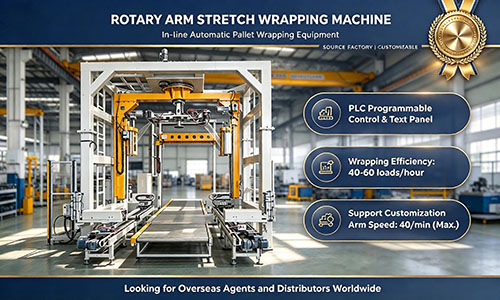
3. Automatic Inline Stretch Wrapping Line
Best for: High-volume 3C electronics manufacturing lines shipping 100+ pallets/day
Capacity: 60–120 pallets/hour
Operation: Fully automatic — film attachment, wrapping, cutting, and clamping with zero operator intervention
Control: PLC with HMI touchscreen, recipe management, and production data logging
Integration: Designed for conveyor-linked end-of-line systems (palletizer → wrapper → strapper → labeler)
Key feature: Programmable wrap patterns with adjustable layers, overlap, and tension per SKU
Price range: $20,000–$60,000+
When to choose: Dedicated production lines with consistent pallet patterns and high throughput requirements.
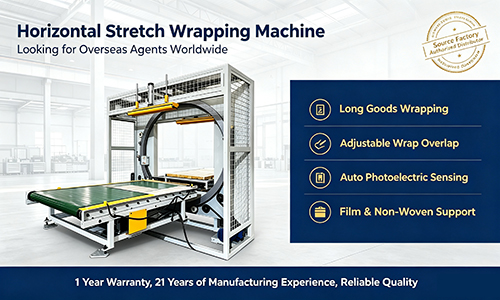
4. Horizontal (Orbital) Stretch Wrapper
Best for: Long or irregular electronics products — LED light bars, aluminum profiles, cable reels, display panels
Wrapping method: Film carriage rotates around the product as it passes through the ring on a conveyor
Applications: Wrapping long electronics components that cannot be palletized conventionally
ESD compatibility: Available with anti-static film carriages
Price range: $5,000–$25,000
When to choose: When your electronics products are elongated, flat-panel, or cannot be stacked on standard pallets.
Industry Application Scenarios
Scenario 1: Semiconductor Manufacturing — Die & Wafer Shipping
Challenge: Semiconductor dies and wafers are among the most ESD-sensitive products in existence. A discharge as low as 10 volts can damage advanced node chips — far below what humans can feel (approximately 3,000V).
Solution:
Use conductive stretch film (10⁴–10⁶ Ω/sq) for outer pallet wrapping
Inner packaging: ESD shielding bags + desiccant + anti-static foam inserts per IPC/JEDEC J-STD-033
Machine: Semi-automatic turntable wrapper with motorized pre-stretch carriage and programmable tension control set to minimum effective containment force
Wrap pattern: 2 layers base + 3 layers body + 2 layers top with reduced tension on top wraps to prevent box crush
Recommended machine: Semi-automatic turntable with inverter-controlled speed and electronic tension feedback.
Scenario 2: Consumer Electronics — Smartphones, Tablets & Laptops
Challenge: Finished consumer electronics ship in retail packaging that is itself fragile — thin aluminum chassis (as thin as 1.3mm), OLED screens (0.55mm panels), and glass backs. Stretch film tension must secure the pallet without crushing carton walls.
Solution:
Use anti-static stretch film (10¹⁰–10¹² Ω/sq) — sufficient for boxed products
Inner-face cling only to prevent outer-face dust attraction on retail packaging
Machine: Rotary arm wrapper with soft-start rotation and adjustable film carriage speed
Tension setting: Containment force limited to 1.5–2.5 kg — enough to stabilize the load, not enough to deform corrugated cartons
Additional: Corner boards or edge protectors on all pallet edges before wrapping
Recommended machine: Rotary arm (cantilever) wrapper — keeps pallets stationary during wrapping, eliminating any risk of product shifting.
Scenario 3: PCB Assembly (PCBA) — Contract Electronics Manufacturing
Challenge: PCB assemblies contain mixed-sensitivity components — some rated for standard ESD protection, others requiring shielding. The wrapping process must be clean, controlled, and compatible with cleanroom-adjacent environments.
Solution:
Film: Static-dissipative grade (10⁹–10¹¹ Ω/sq), 15–20 micron thickness
Machine frame: Must avoid exposed lubrication; prefer sealed bearings and stainless-steel contact surfaces
Cleanroom compatibility: If wrapping inside or adjacent to an ISO 14644-1 Class 7/8 cleanroom, the machine must be specified with HEPA-compatible materials and constant-temperature sealing (not impulse-type, which sheds particles)
Wrap protocol: Individual cartons wrapped in anti-static film, then palletized and stretch-wrapped as a unit
Recommended machine: Semi-automatic or automatic turntable, specified with cleanroom-compatible materials and ESD-safe film carriage components.
FAQ: Stretch Wrapping Machine for Electronics
Q: What is the best stretch wrapper for a small electronics factory?
A: A semi-automatic turntable stretch wrapper with motorized pre-stretch carriage is the best starting point for small electronics factories (20–100 pallets/day). It provides ESD-safe film compatibility, programmable tension control, and consistent wrap quality at an accessible price point ($3,000–$8,000). Choose a rotary arm model if your loads are tall, top-heavy, or too fragile to rotate.
Q: How do I prevent stretch film from crushing electronics cartons?
A: Control the containment force through three settings: (1) reduce pre-stretch ratio to 200–250%, (2) lower the film carriage speed on the top wraps, and (3) use programmable wrap zones to apply less tension on the upper 30% of the load. Add corner boards or edge protectors before wrapping for additional crush protection.
products
Horizontal Stretch Wrapping Machine SP1000 for Pipes
view more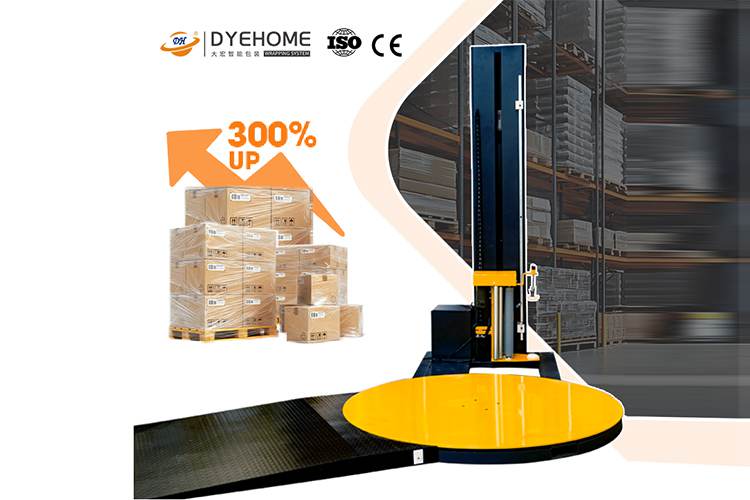
Pallet Stretch Wrapping Machine
view more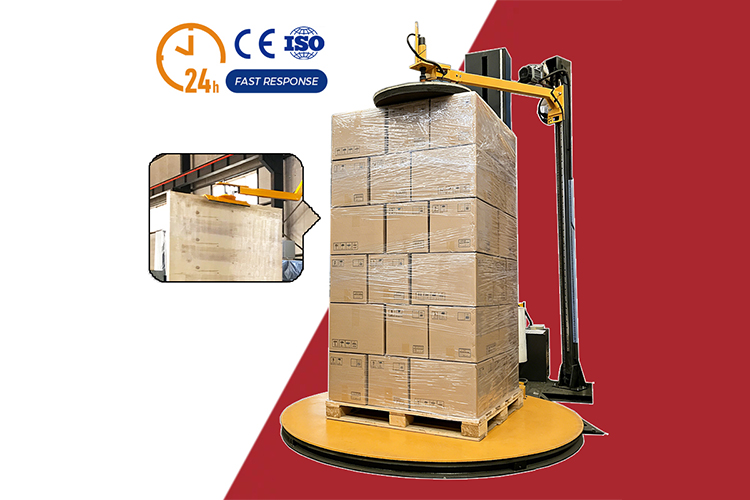
Top Press Pallet Stretch Wrapping Machine
view more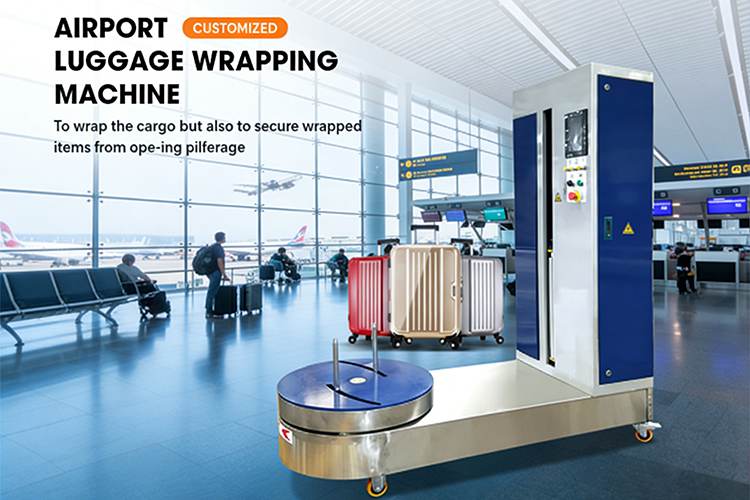
Luggage Wrapping Machine for Airports
view more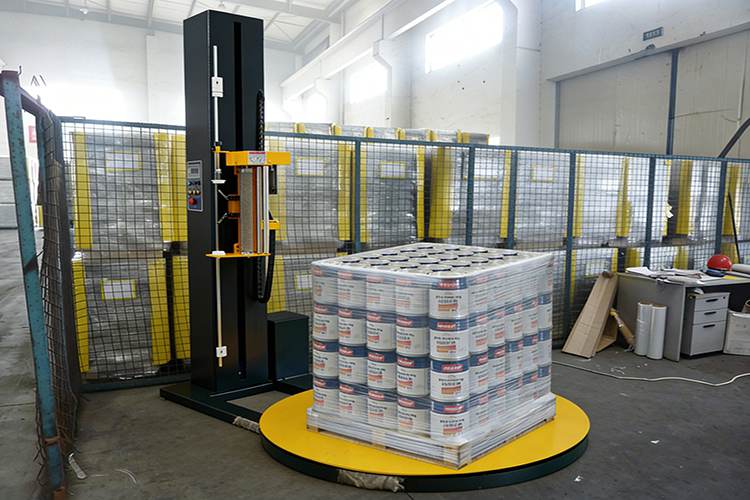
Pallet Stretch Wrapping Machine for Canned Goods
view more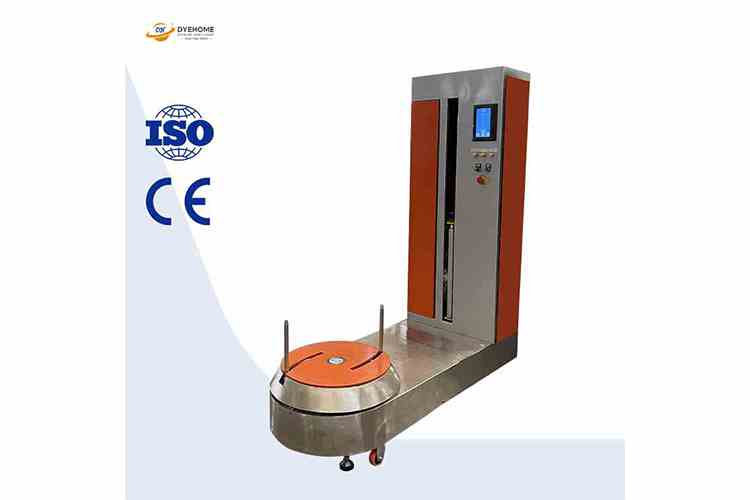
Airport Self-Service Luggage Wrapping Machine
view more
Cantilever wrapping film packaging machine
view more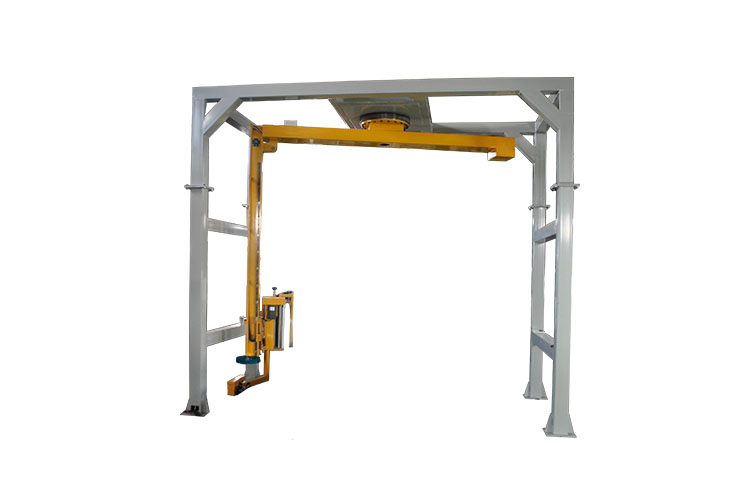
Gantry fully automatic cantilever wrapping machine
view more
 Shandong Dyehome Intelligent Equipment Co.,Ltd
Phone:0086-17362172587
Whatsapp:+8617362172587
Email:machinedyehome@gmail.com
Add:Building 62, 3000 Meili East Road, DmiPark, Wujiapu Street, Huaiyin District, Jinan City,Shandong Province
Jinan Jiasen Packaging Equipment Co., LtdPhone:0086-15665802370
Add:High-end Equipment Manufacturing Industrial Park, East Industrial New Town, Ancheng Town, Pingyin County, Jinan City, Shandong Province
Shandong Golden Pack Intelligent Equipment Co.,LtdPhone:0086-15662690213
Add:High-end Equipment Manufacturing Industrial Park, East Industrial New Town, Ancheng Town, Pingyin County, Jinan City, Shandong Province
YoursIndustry
OurSolutions
OurServices
OurInformation