

Paper Industry Packaging Solutions:Complete Guide to Wrapping Paper Rolls (2026)
Why Paper Industry Packaging Is Uniquely Challenging
Walk through any paper mill and you will immediately notice what sets this industry apart:the product is awkward to handle.Giant paper rolls weighing several tons,long sheets of board on pallets,specialty papers sensitive to moisture—paper products defy the standard approach to end-of-line packaging.
The global paper and pulp industry produces over 400 million metric tons annually,according to the FAO.Yet transportation damage accounts for 3%to 7%of paper product value loss during distribution—a staggering figure across hundreds of millions of tons.
What makes paper industry packaging so difficult?
Roll-shaped cargo:Most paper leaves the mill as large cylindrical rolls that resist conventional pallet wrapping.
Extreme weight:A single paper roll can weigh 500 kg to 3,000 kg or more.
Moisture sensitivity:Paper absorbs humidity quickly,causing dimensional shifts and printability issues.
Long profiles:Sheets and boards often exceed standard pallet dimensions.
In this guide,we break down the major challenges,explore equipment solutions,and show how automated wrapping systems can reduce damage and improve throughput.
The 5 Biggest Packaging Challenges in the Paper Industry
1.Moisture and Humidity Damage
Paper is hygroscopic—it absorbs and releases moisture with ambient humidity.A 5%moisture change can cause dimensional shifts of 0.5%to 1%,enough to ruin print registration.Industry surveys by the AF&PA indicate moisture damage accounts for roughly 35%of all paper shipping claims.Effective packaging requires consistent,overlapping wrap coverage with no gaps.
2.Securing Roll-Shaped Cargo
Cylindrical rolls want to roll.A standard turntable wrapper cannot properly stabilize a standing paper roll,because film cannot grip the curved surface without deforming edges.Cylinder wrapping—where the roll rotates along its axis while film is applied radially—is the only method that creates uniform circumferential tension.
3.Transportation and Handling Damage
Paper rolls and sheet stacks suffer edge crushing,corner impact,and scuffing during transit.The ISTA has documented that paper products experience higher damage rates than almost any other non-fragile industrial category.Automated wrapping with controlled tension can reduce transit damage by 40%to 60%compared to manual methods.
4.Low Manual Packaging Efficiency
Manual wrapping of paper rolls is slow and inconsistent.A worker wrapping a large paper roll takes 10 to 15 minutes,using far more film than necessary.In high-volume mills,manual packaging becomes a serious bottleneck.One automated Cylinder Wrapping Machine replaces 3 to 4 workers while wrapping each roll in just 1 to 3 minutes.
5.Environmental and Sustainability Pressure
The industry is under growing pressure to reduce packaging waste.Manual wrapping uses excessive film because workers cannot consistently optimize stretch.Automated systems with powered pre-stretch reduce film consumption by 30%to 50%,aligning with sustainability goals while cutting costs.
Packaging Equipment Solutions for the Paper Industry
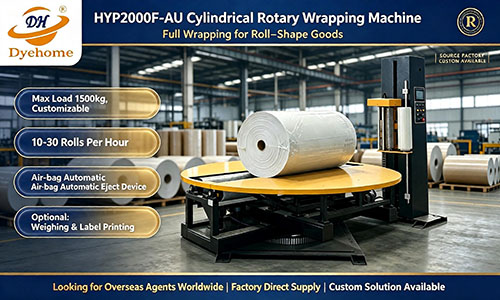
1.Cylinder Wrapping Machine:Ideal for Paper Rolls
The Cylinder Wrapping Machine(or radial wrapper)is purpose-built for cylindrical products like paper rolls and tissue parent rolls.The machine rotates the roll on its Cylinder axis while a film carriage travels back and forth,applying stretch film in a spiral,overlapping pattern.This radial wrapping creates uniform circumferential tension,holding layers together and protecting roll edges from crushing.
2.Turntable Pallet Wrapper:Standard for Sheets and Cartons
For paper sheets,copy paper,and boxed products on standard pallets,the turntable pallet wrapper remains the industry workhorse.Modern turntable wrappers feature powered pre-stretch systems with ratios up to 1:2.5,dramatically reducing film consumption.
3.Rotary Arm Wrapper:Best for Heavy and Unstable Loads
When wrapping extremely heavy paper pallets,rotating the load itself is unsafe.A rotary arm wrapper keeps the pallet stationary while a rotating arm orbits around it.Rotary arm machines are also essential for unstable or tall loads that could topple on a turntable.
4.Inline/Conveyor Wrapper:High-Capacity Mill Automation
For high-volume mills producing hundreds of rolls per shift,inline conveyorized wrappers are the standard.These machines integrate directly with production conveyors,automatically receiving loads,wrapping to programmed recipes,and discharging to shipping—all without operator intervention.
Why the Cylinder Wrapping Machine Is the Gold Standard for Paper Rolls
If there is one machine that defines modern paper roll packaging,it is the Cylinder Wrapping Machine.While turntable and rotary arm machines handle palletized products,the Cylinder wrapper is the only machine designed specifically for cylindrical roll-form paper—which is how the vast majority of bulk paper leaves the mill.
How Cylinder Wrapping Works
In a Cylinder wrapper,the paper roll is supported by powered rollers that rotate it around its Cylinder axis.A film carriage on a linear traverse moves back and forth along the roll length,dispensing pre-stretched film in a precise helical pattern.Overlap percentage,wrap tension,and number of layers are all programmable via the control panel.This radial approach—applying film around the circumference—creates hoop strength that holds the roll together,prevents telescoping,and protects outer layers from scuffing and moisture.
Key Technical Specifications
|
Parameter |
Typical Value |
Benefit for Paper Industry |
|
Pre-stretch ratio |
1:3.5(powered) |
Reduces film use by 30%–50% |
|
Wrap speed |
1–3 min per roll |
3–5x faster than manual |
|
Roll diameter |
300–2,000 mm+ |
Small slitter rolls to giant mother rolls |
|
Roll length |
500–6,000 mm+ |
Tissue,board,and specialty widths |
|
Load capacity |
Up to 5,000 kg |
Handles the heaviest industrial rolls |
|
Film overlap |
Adjustable 30%–70% |
Ensures moisture barrier coverage |
The 1:2.5 pre-stretch ratio deserves special attention.Powered pre-stretch systems use two rollers at different speeds to mechanically stretch film before application.A 500-meter film roll yields 1,250 meters of actual wrap coverage.For high-volume mills,the film savings are substantial—typically 30%to 50%less consumption compared to manual wrapping.
Where Cylinder Wrappers Deliver the Most Value
Tissue and towel mills:Soft parent rolls need controlled tension to protect structural integrity.
Printing and writing paper mills:High-value coated papers require perfect roll geometry and moisture protection.
Packaging board mills:Heavy board rolls demand robust wrapping for rough handling.
Paper tube manufacturers:Long stacks of tubes are natural candidates for Cylinder wrapping.
Specialty paper converters:Thermal paper and label stock require dust-free,moisture-tight packaging.
ROI Analysis:Manual vs.Automated Paper Packaging
Investing in automated packaging is a significant decision—but for most mills,the return on investment comes faster than you might expect.Let us break down the economics using realistic industry figures.
Labor Cost Savings
Consider a mid-sized operation wrapping 80 rolls per shift across two shifts.Manual wrapping at 10 minutes per roll requires about 26.6 worker-hours per day.At$25 per hour including benefits,that equals roughly$172,900 per year in wrapping labor.An automated Cylinder wrapper handles the same volume in 2 minutes per roll with just one operator—replacing 3 to 4 workers.Annual labor cost drops to about$43,000,saving roughly$129,900 per year.
Film Material Savings
Manual wrapping uses 40%to 60%more film than automated wrapping with powered pre-stretch,according to PMMI studies.If you currently spend$120,000 per year on stretch film,switching to an automated system saves$36,000 to$60,000 annually.
Damage Reduction and Claim Savings
If your mill ships$50 million worth of paper annually and 4%is damaged in transit,that is$2 million per year in claims.Automated wrapping can reduce damage by 40%to 60%,saving$800,000 to$1.2 million per year.This is often the single largest component of ROI.
Putting It All Together
Combining labor savings,film savings,and damage reduction,a typical mid-sized operation can expect total annual savings of$200,000 to$500,000.With machine costs ranging from$30,000 to$150,000+,payback periods typically fall between 6 and 18 months.
How to Choose the Right Paper Packaging Equipment
Selecting the right equipment depends on several key factors.
1.What Are You Wrapping?
Paper rolls:You need a Cylinder Wrapping Machine,sized for your roll diameter,length,and weight.
Palletized sheets or cartons:A turntable pallet wrapper is the most cost-effective choice for stable loads.
Heavy or tall pallets:A rotary arm wrapper provides better stability and safety for loads that should not rotate.
Mixed output:You may need both a Cylinder wrapper for rolls and a pallet wrapper for finished goods.
2.What Is Your Production Volume?
Low volume(under 20 per day):A semi-automatic machine may be sufficient.
Medium volume(20–100 per day):A fully automatic machine with conveyors will improve throughput.
High volume(100+per day,24/7):An inline conveyorized system with recipe management is essential.
3.How Much Floor Space Do You Have?
Footprint matters,especially in older mills.Cylinder wrappers need length for the roll plus traverse mechanism;turntable wrappers need clear space around the platform;rotary arm machines need room for the arm to swing.Always measure carefully and discuss layout with your supplier.
4.What Is Your Budget?
Entry-level semi-automatic turntable wrappers start around$10,000 to$20,000,while heavy-duty automatic Cylinder wrappers can run$80,000 to$200,000+.Always calculate total cost of ownership—labor savings,film savings,and damage reduction—rather than just the upfront price.
Ready to Upgrade Your Paper Industry Packaging?
If you are still wrapping paper rolls or pallets by hand—or if your current system is underperforming—now is the time to explore what modern equipment can do.Most mills see a full return on investment within the first year or two.
products
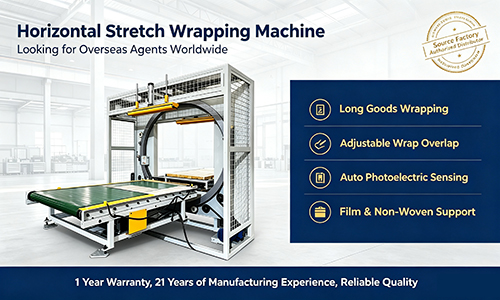
Horizontal Stretch Wrapping Machine SP1000 for Pipes
view more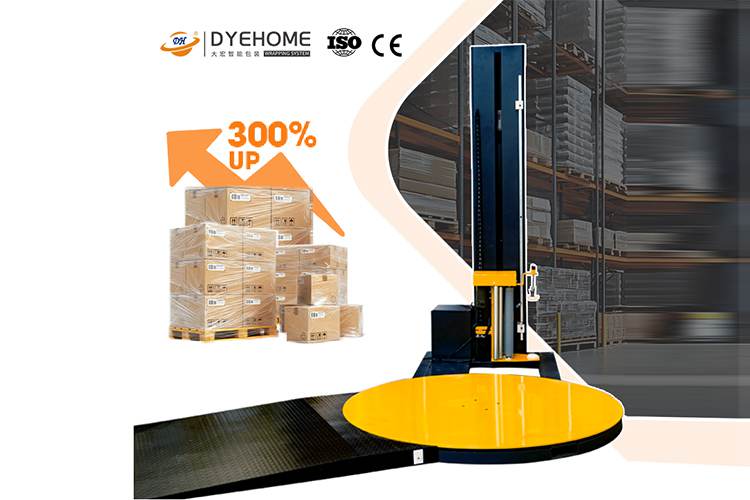
Pallet Stretch Wrapping Machine
view more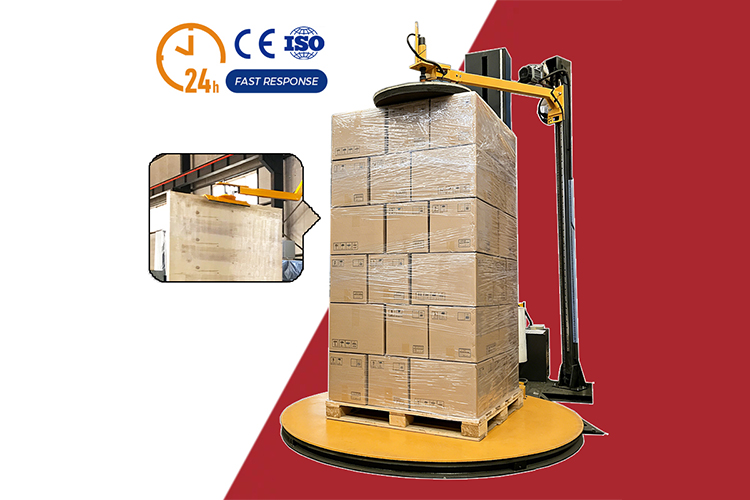
Top Press Pallet Stretch Wrapping Machine
view more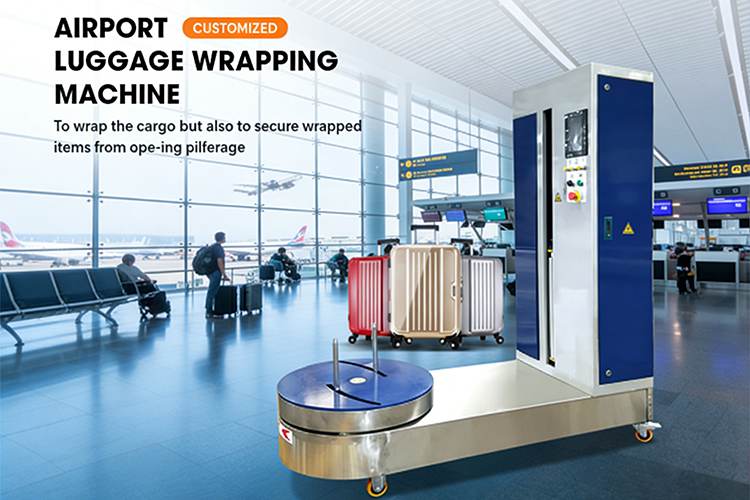
Luggage Wrapping Machine for Airports
view more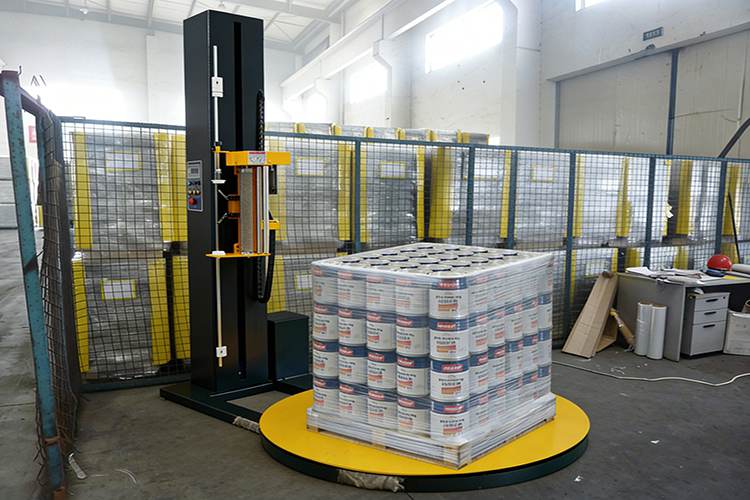
Pallet Stretch Wrapping Machine for Canned Goods
view more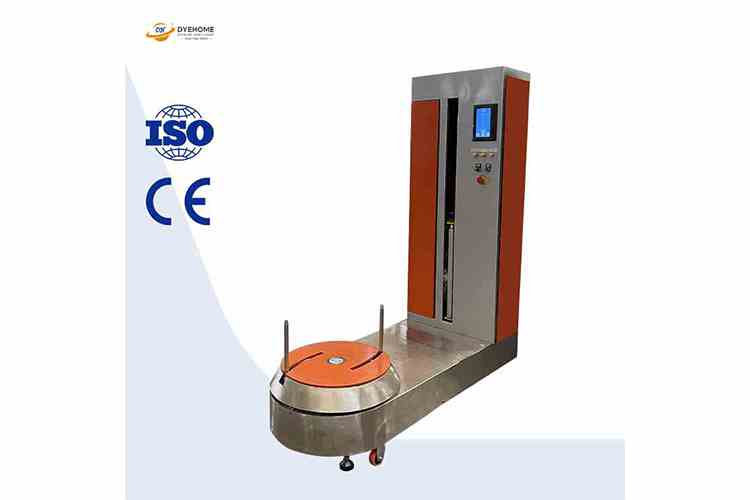
Airport Self-Service Luggage Wrapping Machine
view more
Cantilever wrapping film packaging machine
view more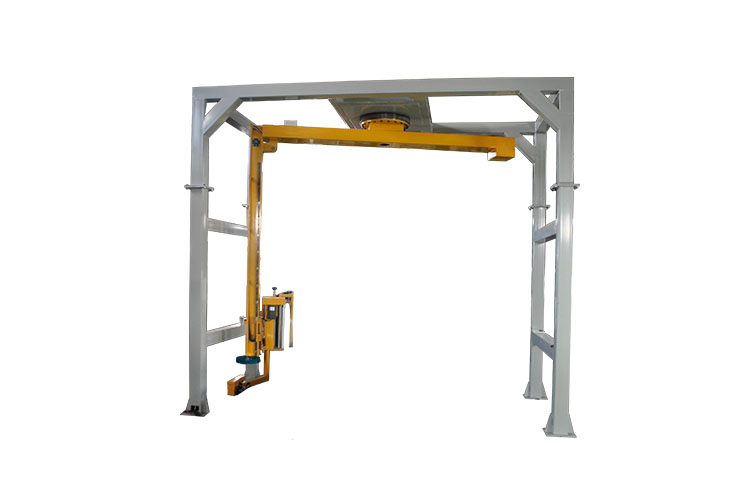
Gantry fully automatic cantilever wrapping machine
view more
 Shandong Dyehome Intelligent Equipment Co.,Ltd
Phone:0086-17362172587
Whatsapp:+8617362172587
Email:machinedyehome@gmail.com
Add:Building 62, 3000 Meili East Road, DmiPark, Wujiapu Street, Huaiyin District, Jinan City,Shandong Province
Jinan Jiasen Packaging Equipment Co., LtdPhone:0086-15665802370
Add:High-end Equipment Manufacturing Industrial Park, East Industrial New Town, Ancheng Town, Pingyin County, Jinan City, Shandong Province
Shandong Golden Pack Intelligent Equipment Co.,LtdPhone:0086-15662690213
Add:High-end Equipment Manufacturing Industrial Park, East Industrial New Town, Ancheng Town, Pingyin County, Jinan City, Shandong Province
YoursIndustry
OurSolutions
OurServices
OurInformation