

Complete Pallet Packaging Line:7-Station Automated Workflow for Cardboard&Mixed Loads(2026)
What Is a Complete Pallet Packaging Line?
A complete pallet packaging line is an integrated end-of-line system that automates the entire packaging workflow—from pallet positioning to final stretch wrapping—through a sequence of dedicated stations connected by conveyor.Unlike standalone machines,a packaging line ensures consistent packaging quality,eliminates manual handling bottlenecks,and adapts to different load types automatically.
A typical high-performance line processes 40–80 pallets per hour with 2–3 operators(vs.8–12 for manual wrapping),reduces film consumption by 30–50%through powered pre-stretch,and delivers uniform containment force that cuts transit damage by 40–60%.
This guide walks through each station of a proven 7-station pallet packaging line designed for cardboard boxes,mixed loads,and both palletized and non-palletized goods.
The 7-Station Workflow
The following workflow is engineered for facilities that handle cardboard box packaging on pallets,with flexibility to accommodate non-palletized loads(e.g.,loose bundles,oversized items,irregular shapes).
Workflow Overview
|
Station |
Function |
Cycle Time |
Key Benefit |
|
1 |
Pallet Centering |
5–10 sec |
Ensures consistent positioning for downstream automation |
|
2 |
Conveying |
10–30 sec |
Transports load between stations at controlled speed |
|
3 |
Corner Protection |
8–15 sec |
Applies corner boards to prevent strap/film damage |
|
4 |
Top-Press Strapping |
15–25 sec |
Secures load with top-press straps for stability |
|
5 |
Top Sheet Covering |
10–20 sec |
Places protective top sheet for dust/moisture protection |
|
6 |
Pallet Lifting |
5–10 sec |
Lifts pallet for base wrap access |
|
7 |
Rotary Arm Stretch Wrapping |
40–90 sec |
Applies uniform stretch film with rotary arm technology |
Total line cycle time:93–200 seconds per load(depending on configuration and wrap parameters)
Station 1:Pallet Centering
Purpose:Automatically aligns the pallet to the conveyor centerline,ensuring every load enters the line in the same position.
How it works:
The pallet is placed on the centering station(manual or via forklift)
Motorized side guides or centering cylinders push the pallet to the precise center position
Sensors confirm alignment before releasing the load to Station 2
Why it matters:
Without consistent pallet positioning,downstream stations(especially corner protection applicators and strapping heads)will misalign,causing:
Straps applied at wrong positions→load instability
Corner boards misaligned→film puncture risk
Rotary arm wrapping off-center→uneven film distribution
Station 2:Conveying
Purpose:Transports the pallet through each station at controlled speed,maintaining synchronization across the line.
How it works:
Chain conveyor,roller conveyor,or belt conveyor moves the pallet between stations
Variable frequency drive(VFD)controls speed for smooth acceleration/deceleration
Photoelectric sensors track pallet position and trigger downstream stations
Accumulation zones allow buffering between stations to prevent bottlenecks
Conveyor types for packaging lines:
|
Type |
Best For |
Speed Range |
Load Capacity |
|
Chain conveyor |
Heavy pallets(>1,500 kg) |
5–15 m/min |
3,000+kg |
|
Roller conveyor |
Standard pallets,smooth bottoms |
10–30 m/min |
1,500 kg |
|
Belt conveyor |
Light loads,non-palletized items |
10–25 m/min |
500 kg |
|
Modular belt |
Mixed loads,washdown environments |
10–20 m/min |
1,000 kg |
Integration note:The conveyor system is the backbone of the line.All stations must be synchronized to the conveyor speed to prevent collisions,misalignment,or production bottlenecks.
Station 3:Corner Protection
Purpose:Automatically applies corner boards(edge protectors)to the four vertical edges of the pallet load before strapping.
How it works:
Corner board magazine stores L-shaped cardboard or plastic edge protectors
Pneumatic or servo-driven applicators pick and place corner boards on all four edges
The applicator adjusts to different pallet heights automatically
Sensors verify all 4 corners are populated before releasing the load
Why corner protection is critical:
Prevents strapping from crushing cardboard boxes
Distributes strap tension evenly across the load
Protects edges during stretch wrapping(film tends to cut into unprotected corners)
Reduces transit damage at corners by 60–80%(industry field data)
Station 4:Top-Press Strapping
Purpose:Applies horizontal and/or vertical straps to secure the load before stretch wrapping.The top-press mechanism pushes down on the load during strapping to eliminate gaps and ensure tight bundling.
How it works:
The pallet enters the strapping station
A top-press plate descends to compress the load(eliminating air gaps between boxes)
Strapping heads apply 2–4 straps(horizontal or vertical pattern)around the load
Straps are tensioned,sealed(friction weld or metal clip),and cut
Top press retracts,conveyor releases the load
Why top-press matters for cardboard packaging:
Cardboard boxes are rarely perfectly uniform.Stacked pallets often have air gaps between layers,uneven surfaces,or slight overhang.Without top-press compression:
Straps sit loose→load shifts during transit
Boxes at the top layer get crushed by strap tension
Stretch wrapping amplifies the instability
Station 5:Top Sheet Covering
Purpose:Automatically places a protective top sheet(cardboard,corrugated board,or stretch film sheet)over the pallet load.
How it works:
Top sheet magazine stores flat sheets(cardboard or film)
Suction cups or mechanical grippers pick the top sheet from the magazine
A placement frame positions the sheet over the load
The sheet is released and smoothed onto the top surface
Why top sheet covering is important:
Dust protection:Critical for food,pharmaceutical,and electronics shipments
Moisture barrier:Prevents water damage during outdoor storage or container shipping
Stacking support:Distributes weight when pallets are stacked in warehouses or containers
UV protection:Prevents sun fading for printed packaging during transport
Anti-theft:Obscures the load contents from view
Technical specs:
|
Parameter |
Specification |
|
Top sheet material |
Cardboard,corrugated board,PE film,kraft paper |
|
Sheet size |
Adjustable to pallet dimensions(up to 1,400×1,400 mm) |
|
Magazine capacity |
50–100 sheets |
|
Application cycle |
10–20 seconds |
|
Auto-adjustment |
Detects pallet size,adjusts placement position |
Station 6:Pallet Lifting
Purpose:Lifts the pallet slightly off the conveyor to expose the base,enabling the rotary arm wrapper to apply film around the bottom of the pallet.
How it works:
A lifting mechanism(scissor lift or hydraulic platform)raises the pallet 50–100 mm
The conveyor stops,and the pallet is held in the lifted position
The rotary arm wrapper(Station 7)wraps film around the exposed base
After wrapping,the pallet is lowered back onto the conveyor
Why pallet lifting is essential:
Without lifting,the bottom 50–100 mm of the pallet remains unwrapped—creating a weak point where:
Load can shift sideways during transport
Moisture enters from the base
Fork operators can catch the film edge and tear it
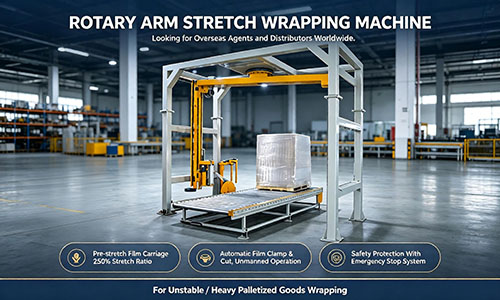
Station 7:Rotary Arm Stretch Wrapping
Purpose:Applies stretch film around the pallet load using a rotating arm system—the final and most critical step in the packaging line.
How it works:
A vertical arm with a powered pre-stretch film carriage rotates around the stationary pallet
Film is applied in a programmed spiral pattern(bottom wraps,body wraps,top wraps)
Powered pre-stretch stretches the film 200–300%before application,maximizing containment force while minimizing film usage
The wrapping program is automatically adjusted based on pallet height(detected by sensors)
Rotary arm vs.turntable for packaging lines:
|
Feature |
Turntable |
Rotary Arm |
|
Load movement |
Load rotates on platform |
Load stays stationary |
|
Max load weight |
1,500–2,500 kg |
3,000+kg(no platform limit) |
|
Load stability |
Centrifugal risk for tall loads |
Zero rotation=zero risk |
|
Line integration |
Requires turntable pit or ramp |
Flat conveyor pass-through |
|
Floor space |
~9 m²(including clearance) |
15–30 m²(arm sweep radius) |
|
Speed |
30–40 loads/hr |
15–25 loads/hr |
|
Best for |
Standard,stable pallets |
Tall,heavy,or unstable loads |
Why rotary arm is preferred for integrated packaging lines:
Load stability:The pallet never moves—critical after corner protection,strapping,and top sheet application(all of which could be disturbed by rotation)
Line integration:Pallets pass through on the conveyor without transfer to/from a turntable platform
Weight capacity:No platform weight limit—handles the heaviest cardboard box pallets
Flexibility:Accommodates both standard pallets and oversized/non-palletized loads
products

Cantilever wrapping film packaging machine
view more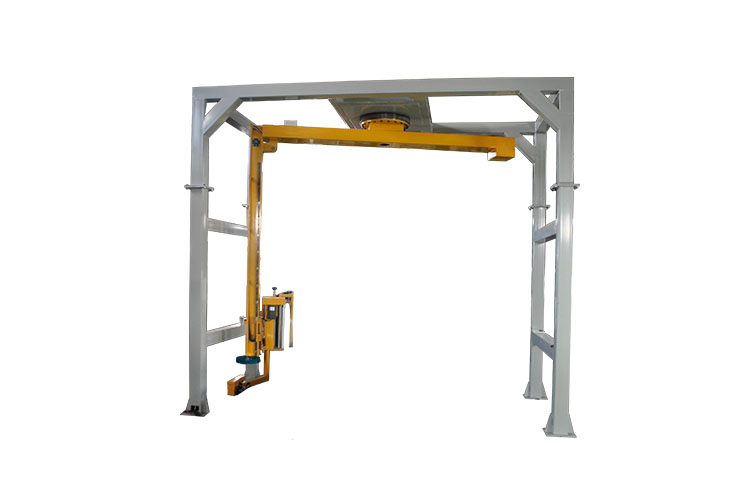
Gantry fully automatic cantilever wrapping machine
view more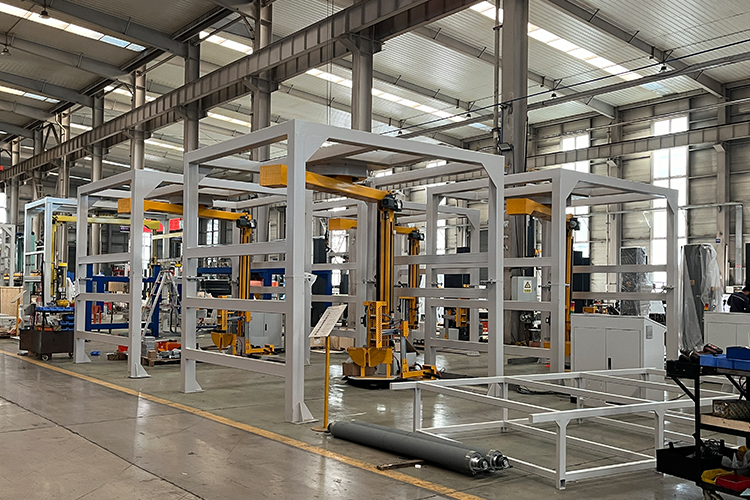
Cantilever wrapping packaging machine
view more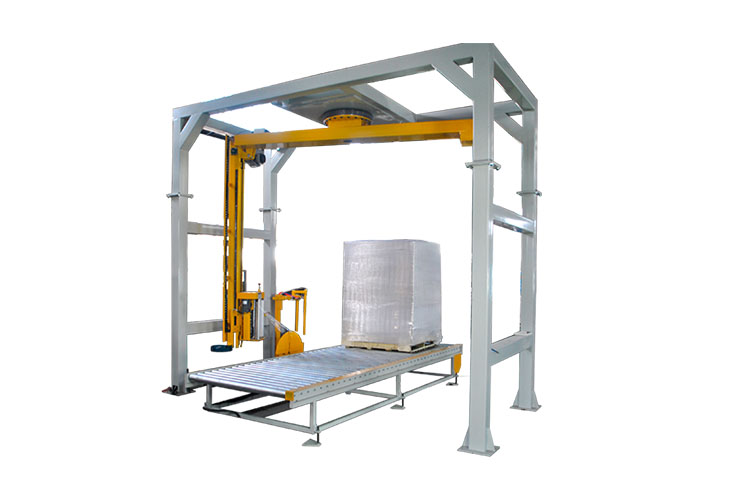
Rocker-type online wrapping machine
view more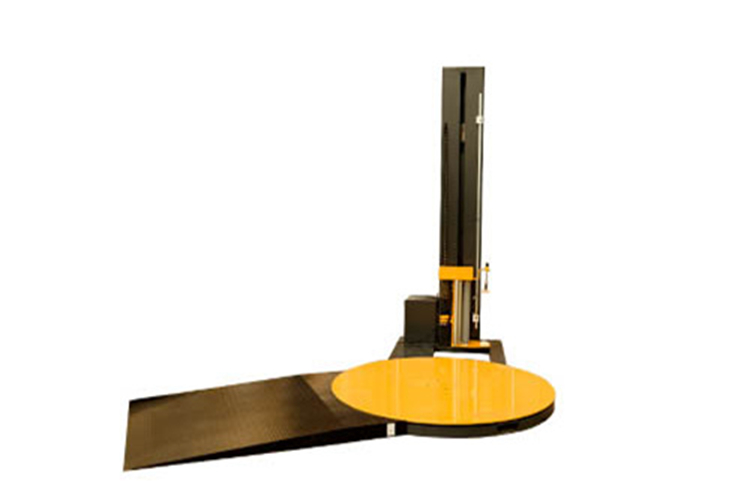
Stretch film wrapping machine
view more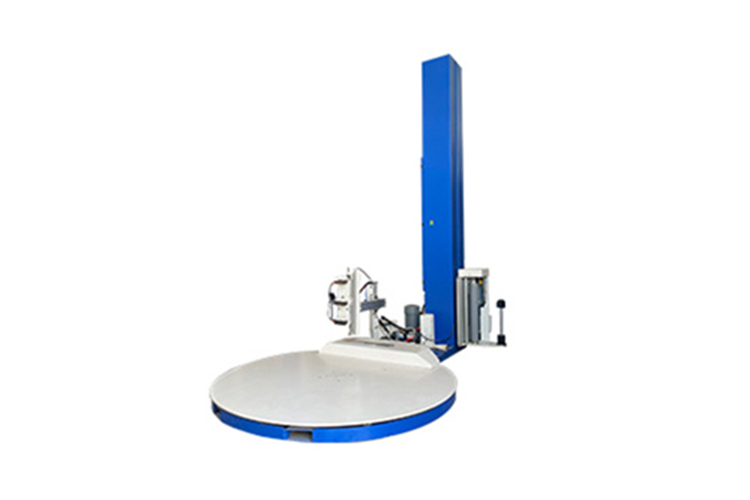
Pallet wrapping packaging equipment
view more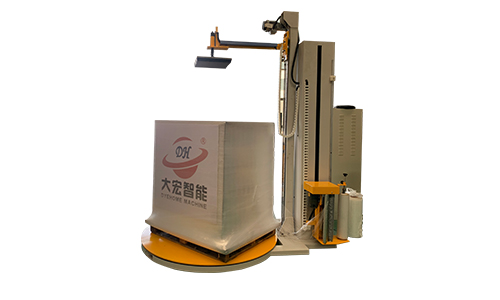
Turntable wrapping machine with top pressure
view more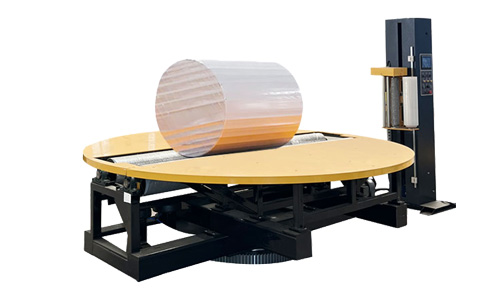
Pallet paper tube wrapping machine
view more
 Shandong Dyehome Intelligent Equipment Co.,Ltd
Phone:0086-17362172587
Whatsapp:+8617362172587
Email:machinedyehome@gmail.com
Add:Building 62, 3000 Meili East Road, DmiPark, Wujiapu Street, Huaiyin District, Jinan City,Shandong Province
Jinan Jiasen Packaging Equipment Co., LtdPhone:0086-15665802370
Add:High-end Equipment Manufacturing Industrial Park, East Industrial New Town, Ancheng Town, Pingyin County, Jinan City, Shandong Province
Shandong Golden Pack Intelligent Equipment Co.,LtdPhone:0086-15662690213
Add:High-end Equipment Manufacturing Industrial Park, East Industrial New Town, Ancheng Town, Pingyin County, Jinan City, Shandong Province
YoursIndustry
OurSolutions
OurServices
OurInformation