

Airport Luggage Wrapping Machine for Protective Packaging
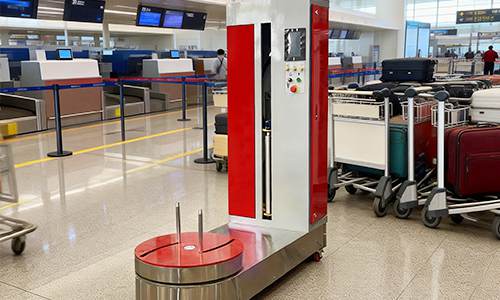
Higher Requirements for Luggage Protection in Travel Scenarios
In airports and transportation hubs, luggage undergoes multiple handling and sorting processes, increasing the risk of scratches, compression, and item loss. Manual wrapping methods are inefficient and inconsistent, especially during peak hours. Airport luggage wrapping machines provide a reliable solution through automatic film wrapping.
Compact Turntable and Film Carriage Design
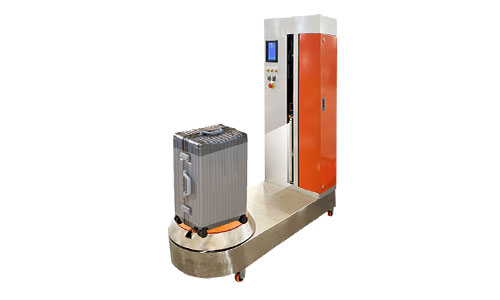
The machine typically features a turntable structure, including a rotating platform, vertical film carriage, and control system. Luggage is placed on the turntable, which rotates while the film wraps around it. The compact design requires minimal space and is suitable for airport check-in or baggage service areas.
Multi-Layer Wrapping for Full Coverage
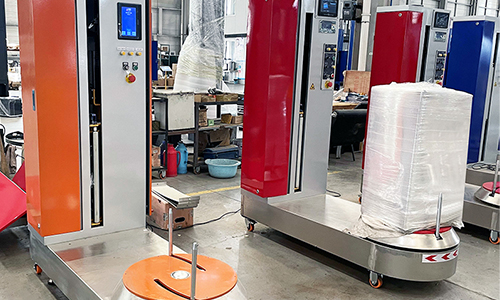
During operation, the operator places the luggage on the machine and starts the process. The turntable rotates, and the film wraps around the luggage in multiple layers, achieving six-sided protection. This enhances durability and prevents damage during transit.
Easy Operation for High-Frequency Use
The machine is equipped with a basic control system that allows adjustment of rotation speed and wrapping layers. The film carriage includes tension control to ensure uniform wrapping. Some models support foot pedal operation and optional modules such as weighing or billing systems for convenient use.
Enhanced Protection and Service Efficiency
Wrapped luggage is more resistant to scratches, dust, and moisture. The packaging also helps secure loose items and improves overall compactness. The quick operation process allows high throughput, making it suitable for busy locations.
Widely Used in Transportation Hubs
This equipment is commonly used in airports, railway stations, bus terminals, and travel service centers. It provides value-added services for passengers and improves luggage handling standards across transportation systems.
Improving Efficiency in Peak Travel Periods
During peak travel times, manual wrapping methods struggle to meet demand. After adopting luggage wrapping machines, airports can significantly improve efficiency. The machines operate reliably and reduce waiting times, enhancing overall passenger experience.
-
 Shandong Dyehome Intelligent Equipment Co.,Ltd
Phone:0086-17362172587
Whatsapp:+8617362172587
Email:machinedyehome@gmail.com
Add:Building 62, 3000 Meili East Road, DmiPark, Wujiapu Street, Huaiyin District, Jinan City,Shandong Province
Jinan Jiasen Packaging Equipment Co., LtdPhone:0086-15665802370
Add:High-end Equipment Manufacturing Industrial Park, East Industrial New Town, Ancheng Town, Pingyin County, Jinan City, Shandong Province
Shandong Golden Pack Intelligent Equipment Co.,LtdPhone:0086-15662690213
Add:High-end Equipment Manufacturing Industrial Park, East Industrial New Town, Ancheng Town, Pingyin County, Jinan City, Shandong Province
-
YoursIndustry
-
OurSolutions
-
OurServices
-
OurInformation