

Pallet Wrapping Machine for Small Business(2026)
If your team still wraps pallets by hand,you already know the hidden costs:inconsistent loads that shift in transit,film bills that creep up every quarter,and operators spending hours a day on a task a machine does in ninety seconds.The problem for small businesses is not whether to automate—it is choosing a machine sized for your reality:10–50 pallets a day,one shift,a hand pallet truck instead of a conveyor line,and a capital budget measured in thousands,not hundreds of thousands.
This guide gives you a direct answer,a type-by-type comparison,the features that actually matter at small-business volumes,and the real cost math so you can justify the purchase to yourself—or your CFO.
The Short Answer:What Is the Pallet Wrapping Machine for a Small Business?
For most small businesses wrapping 10–50 pallets per day,the pallet wrapping machine is a semi-automatic turntable wrapper with a powered pre-stretch carriage rated at 250–300%.It requires no conveyor,no civil works,and no dedicated operator;it cuts stretch film consumption by 30–50%compared with hand wrapping;and it typically pays for itself in 6–18 months through labor and film savings.
Choose a self-propelled(robotic)wrapper instead if you wrap at multiple locations,have no fixed wrapping bay,or handle oversized pallets that will not fit a standard turntable.Skip fully automatic inline systems entirely until you consistently exceed 80–100 pallets per day—below that threshold,the economics do not work.
What"Small Business"Means in Pallet Wrapping Terms
Equipment sizing starts with an honest definition of your operation.In pallet wrapping,a small business profile typically looks like this:
Volume:10–50 pallets per day,single shift
Material handling:hand pallet truck or one forklift—no powered conveyor line
Labor:no dedicated packaging engineer;the operator has other duties
Space:wrapping happens on open floor,often near the dock
Budget:roughly$2,000–$15,000 for equipment
|
Daily Volume |
Recommended Approach |
|
Under 10 pallets/day |
Hand wrapping can still be tolerable,but watch film waste and ergonomics |
|
10–50 pallets/day |
Semi-automatic turntable wrapper—the small-business sweet spot |
|
50–100 pallets/day |
Heavy-use semi-automatic,or entry-level automatic with auto film cut |
The 80–100 pallets per day mark is the widely cited ROI breakpoint for fully automatic equipment,because only above it do labor savings fund the roughly$50,000+investment in automation and conveyors within a reasonable window.Below it,a semi-automatic machine captures most of the available savings at a fraction of the cost.
4 Machine Types Worth Considering(and One to Skip)
1.Semi-Automatic Turntable Wrapper—the Default Choice
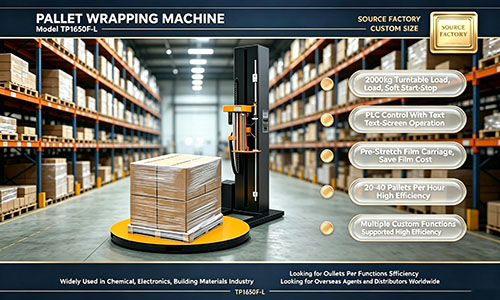
The operator places the pallet on the turntable(by forklift,or by pallet jack up a ramp),attaches the film,presses start,and cuts the film at the end.The machine does the actual wrapping:rotation,carriage travel,pre-stretch,and wrap pattern.
A representative industrial example is the Dyehome semi-automatic turntable series:1,650 mm turntable,2,000 kg capacity,10–30 loads per hour,250–300%powered pre-stretch,adjustable 0–12 RPM turntable speed,photo-eye load-height sensing,and a 110/220/380 V power supply that works with ordinary shop power.At 1.55 kW installed power,running costs are negligible—a few dollars of electricity per month at small-business duty cycles.
2.Semi-Automatic with Ramp—When You Don't Have a Forklift
A reinforced entry ramp lets a hand pallet truck roll the pallet directly onto the turntable.For small e-commerce shippers,workshops,and rented units where a forklift is not always available,the ramp option removes the single biggest operational dependency.It occupies minimal floor space and can usually be retrofitted.
3.Self-Propelled(Robotic)Wrapper—No Fixed Installation
A robotic wrapper drives itself around a stationary pallet.There is no turntable to bolt down,no dedicated bay,and no pallet size limit—the machine comes to the load.Dyehome's SCR-600 self-propelled wrapper,for example,handles loads of virtually any size and weight,which suits businesses wrapping in several spots,sharing space with other operations,or handling occasional oversized or irregular pallets.Throughput is lower(roughly 15–25 loads per hour depending on travel distance)and the price is higher than a turntable,but the flexibility is unmatched.
Type Comparison Table
|
Dimension |
Semi-Auto Turntable |
Semi-Auto with Ramp |
Self-Propelled Robot |
Fully Automatic Inline |
|
Throughput |
10–30 loads/hr |
10–30 loads/hr |
15–25 loads/hr |
40–120+loads/hr |
|
Typical price |
$2,000–$6,000 |
+$300–$800 |
$15,000–$30,000 |
$50,000+(plus conveyors) |
|
Footprint |
~2.5×1.7 m |
+ramp length |
None fixed(parks anywhere) |
Full line,15 m+ |
|
Loading method |
Forklift or pallet jack |
Hand pallet jack |
Pallet stays on floor |
Conveyor |
|
Installation |
Plug-and-play |
Plug-and-play |
None |
Professional integration |
|
for |
Most small businesses |
No forklift on site |
Multi-point/oversized loads |
100+pallets/day |
7 Features That Matter Most at Small-Business Volumes
1.Powered Pre-Stretch,250–300%
Film is the largest lifetime cost of wrapping—for most operations it exceeds the machine price within two to four years.A powered pre-stretch carriage stretches each meter of film into 2.5–3 meters before it touches the load,cutting film consumption 30–50%versus hand wrapping or brake-type carriages.This single feature drives most of the ROI.Avoid machines that top out at 100–150%mechanical stretch.
2.Variable Turntable Speed with Soft Start/Stop
Small businesses wrap mixed loads—heavy hardware one hour,lightweight cartons the next.An adjustable 0–12 RPM turntable with frequency-inverter soft start and stop lets fragile or top-heavy loads wrap gently without shifting.
3.Photo-Eye Automatic Height Sensing
A photo-eye that detects load height automatically means any employee can wrap any pallet correctly without programming.Look for quality sensing components—Dyehome,for instance,builds its turntable line with Panasonic photo-eyes,Omron switches,and Inovance PLC,inverter,and touchscreen,the tier of components that keeps a machine running for a decade rather than two years.
4.PLC Controls with Wrap Recipes
A PLC with a touchscreen lets you store wrap programs—bottom wraps,top wraps,tension,overlap—per product type.For a small team with turnover,recipes eliminate training drift:press the button for"Product A"and the wrap is identical every time.
5.Ramp Compatibility
If there is any chance you will load with a hand pallet truck,confirm the machine accepts a ramp.Buying the ramp later is usually possible;buying a machine that cannot accept one is not fixable.
6.Real Safety Hardware
Even at low volumes,insist on an emergency stop,enclosed wiring and motors,a guarded film carriage(CE-certified carriage design on Dyehome's ramp model,for example),and a turntable sized so the pallet does not overhang and create a trip hazard.Hand wrapping is a documented ergonomic hazard—lifting,bending,and repetitive motion—and a machine should remove risk,not relocate it.
7.A Modular Upgrade Path
Your volume will grow.A modular machine lets you bolt on options later—an integrated scale,a top press platen for unstable loads,automatic film clamp and cut,or an M-type turntable for pallet-jack loading from all four sides—without replacing the base machine.Dyehome's turntable platform supports all of these as add-on modules,which effectively future-proofs the purchase.
The Real Cost Math for a Small Business
Here is a transparent,conservative calculation for a business wrapping 30 pallets per day,250 days per year:
Labor savings.Hand wrapping takes roughly 4–6 minutes per pallet;a semi-automatic machine cycle takes about 1.5 minutes of operator attention.Saving 3.5 minutes×30 pallets=105 minutes(1.75 hours)per day at a loaded warehouse labor rate of about$30/hour yields:
1.75 hr/day×$30×250 days= $13,125 per year
Film savings.A 250%pre-stretch carriage cuts film use 30–50%.On a modest film spend of$3,000 per year,that is $900–$1,500 per year —more if you wrap heavier or taller loads.
Total:roughly$14,000–$14,600 per year against a machine cost of$4,000–$6,000.That implies payback in as little as 4–6 months at 30 pallets per day;at lower volumes or lower labor rates,6–18 months is a safe planning range.The machine then returns that amount every year for a service life of 10+years on a well-built frame.
Two caveats keep this honest.First,these are illustrative figures—substitute your own wage rate,film spend,and volume.Second,the math ignores damage reduction,which is real but harder to predict:consistent machine-applied containment force simply does not vary the way hand wrapping does at 4:45 p.m.on a Friday.The global picture supports the same direction—the pallet stretch wrapping machine market was valued at about$3.8 billion in 2025 and is projected to reach$7.29 billion by 2036(Grand View Research),growth driven largely by small and mid-size operations making exactly this first automation step.
Which Setup Fits Your Scenario?
Scenario A—E-commerce shipper or small 3PL,15–40 pallets/day,pallet jack only.
Semi-automatic turntable with ramp and photo-eye height sensing.No forklift dependency,minimal training,footprint under 4 m²including the ramp.
Scenario B—Small manufacturer,30–60 pallets/day,mixed SKUs.
Heavy-duty semi-automatic(1,650 mm turntable,2,000 kg rating)with PLC recipes per product family,plus the top-press module if any loads are unstable.Add the integrated scale module if you ship LTL and want weight verification at the wrap station.
Scenario C—Multiple wrap points,oversized pallets,or no dedicated floor space.
Self-propelled robotic wrapper(e.g.,Dyehome SCR-600).One machine serves several lines,parks anywhere,and wraps pallets too large for any turntable.
FAQ
Q:How many pallets per day justify buying a pallet wrapping machine?
A:The practical threshold is around 10 pallets per day.Below that,hand wrapping is tolerable;above it,labor time and film waste make a semi-automatic machine pay for itself,typically within 6–18 months.Fully automatic systems only make economic sense above roughly 80–100 pallets per day,where savings can fund the$50,000+investment.
Q:Should a small business choose a semi-automatic or a robotic pallet wrapper?
A:Choose semi-automatic if you wrap in one fixed location on standard pallets—it is far cheaper($2,000–$6,000 vs$15,000–$30,000)and faster per load.Choose a self-propelled robotic wrapper if you wrap at multiple points,lack a dedicated wrapping bay,or handle oversized pallets that exceed turntable dimensions.


 Shandong Dyehome Intelligent Equipment Co.,Ltd
Phone:0086-17362172587
Whatsapp:+8617362172587
Email:machinedyehome@gmail.com
Add:Building 62, 3000 Meili East Road, DmiPark, Wujiapu Street, Huaiyin District, Jinan City,Shandong Province
Jinan Jiasen Packaging Equipment Co., LtdPhone:0086-15665802370
Add:High-end Equipment Manufacturing Industrial Park, East Industrial New Town, Ancheng Town, Pingyin County, Jinan City, Shandong Province
Shandong Golden Pack Intelligent Equipment Co.,LtdPhone:0086-15662690213
Add:High-end Equipment Manufacturing Industrial Park, East Industrial New Town, Ancheng Town, Pingyin County, Jinan City, Shandong Province
YoursIndustry
OurSolutions
OurServices
OurInformation